
No, AI will not replace digital marketers completely, but digital marketers who use AI will replace those who do not. Artificial Intelligence has transitioned from a futuristic novelty into an everyday workforce reality. This shift has triggered significant anxiety across the industry, forcing professionals to wonder if their roles face imminent obsolescence.
The reality is nuanced. AI is radically transforming the digital marketing landscape by automating repetitive tasks, reshaping job descriptions, and shifting the core value proposition of human professionals from execution to strategy.
What AI Excels At: The Automated Execution
Artificial intelligence operates with unmatched speed, data-processing capacity, and 24/7 availability. It easily outperforms humans in structural, repetitive, and deeply analytical tasks.
- Data Analysis & Reporting: Sifting through massive datasets to spot conversion trends.
- Content Drafting: Generating initial outlines, social captions, and product descriptions.
- Programmatic Advertising: Adjusting ad bids and executing real-time A/B testing.
- SEO Automation: Conducting massive keyword research and tracking search engine result pages.
For basic technical execution, AI has successfully lowered the barriers to entry. Marketing teams using these systems are saving an average of 11 hours per week, allowing them to reinvest that time into higher-level business growth.

Why Humans Remain Irreplaceable
Despite its processing power, AI lacks the foundational traits required to build long-term brand equity: empathy, original creativity, and strategic intent. Marketing is not just about outputting data; it is about building deep, lasting relationships with human consumers. [1, 2, 3]
1. Emotional Intelligence and Empathy
AI can mimic human language patterns based on historical data, but it cannot truly feel or understand human emotions. It lacks humor, cultural nuance, and the ability to navigate delicate social crises. Authentic, trust-based storytelling still requires a human heart. [1, 2, 3, 4, 5]
2. Strategic Thinking and Business Vision
AI is exceptionally good at answering the “how” of a task, but it struggles with the “why”. It cannot organically understand a company’s long-term business vision, make high-stakes ethical trade-offs, or define overarching brand positioning. Humans must set the goals and hold accountability for the commercial outcomes.
3. True Innovation vs. Pattern Replication
Generative AI creates content by identifying patterns in existing datasets. It cannot think outside its training data. True creative breakthroughs—campaigns that break conventions and capture the cultural zeitgeist—come from human intuition and life experiences.

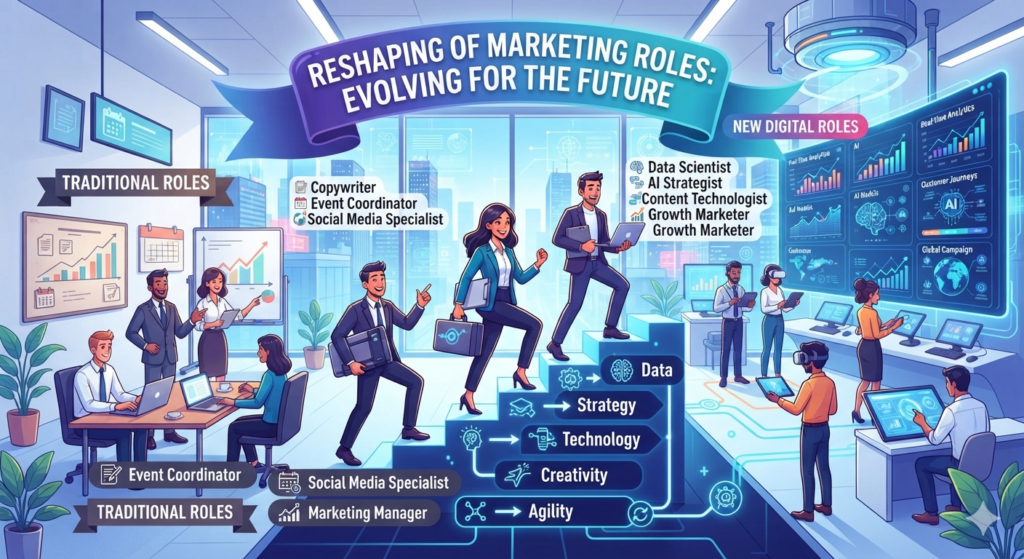
The Reshaping of Marketing Roles
According to the World Economic Forum, the future of work involves a massive redistribution of tasks. While low-skill execution roles are facing intense downward pressure, new hybrid positions are rapidly emerging. The industry is actively shifting toward specialized functions:
| Traditional Role | Evolution Under AI | Key Human Skill Required |
|---|---|---|
| Content Writer | Content Experience Director | Brand Voice Editing & Storytelling |
| Data Entry Clerk | Marketing Data Scientist | Insight Interpretation & Strategy |
| Media Buyer | AI Marketing Strategist | System Management & Prompting |
Rather than eliminating marketing departments, AI is acting as an ultra-efficient sidekick. It handles the heavy operational lifting so that humans can step into creative direction and customer journey architecture.
How Marketers Can Stay Ahead
To remain highly competitive in an AI-driven economy, digital marketers must intentionally upgrade their skill sets.
- Master AI Tools: Learn prompt engineering and integrate platforms into your workflow.
- Focus on Psychology: Deepen your understanding of consumer behavior and cultural trends.
- Develop Commercial Judgment: Tie marketing metrics directly to business revenue and growth.
- Sharpen Project Management: Move from being a tool operator to managing holistic digital systems.

Final Verdict
The digital marketing profession is not dying; it is undergoing a critical filter. Passivity, lazy copy-pasting, and strict resistance to new tools will lead to career displacement. However, for professionals who embrace technology, master data interpretation, and champion human empathy, the future looks incredibly bright. The tools are changing, but the core mission remains the same: connecting brands with people.